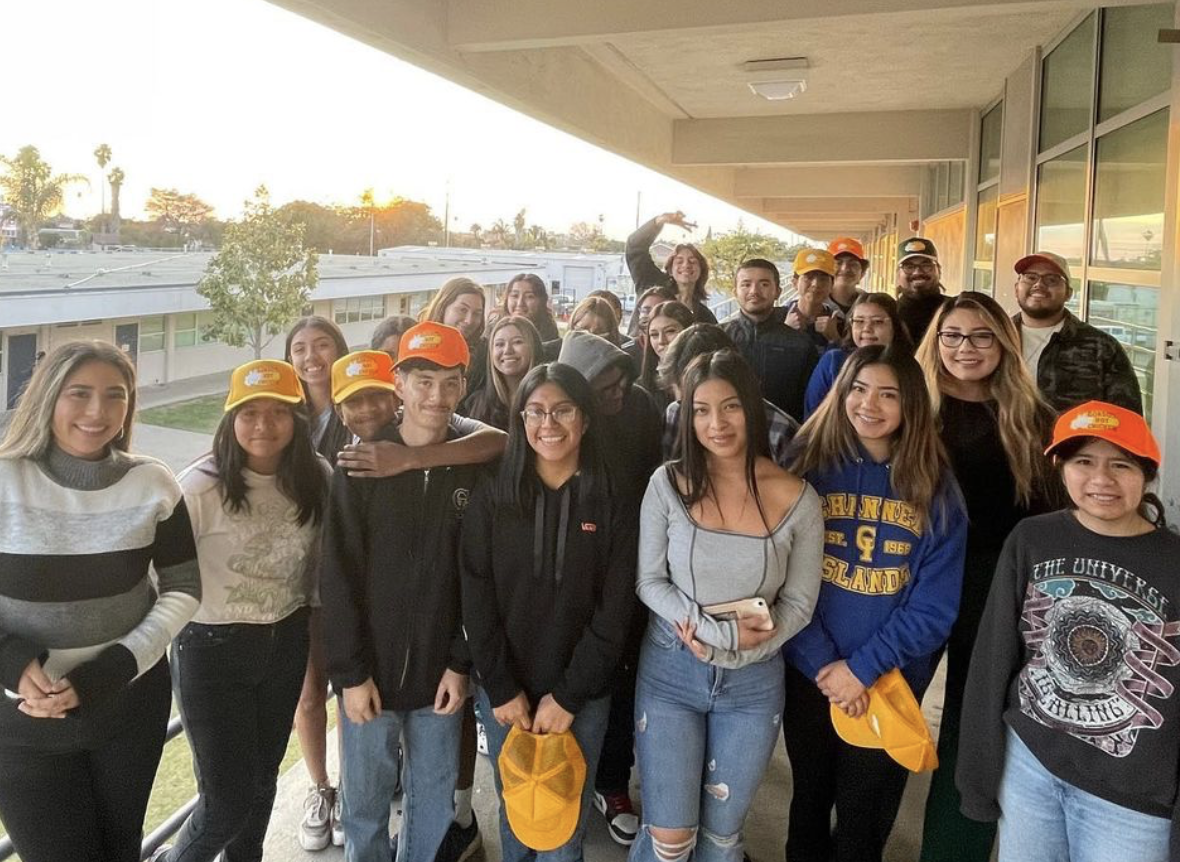


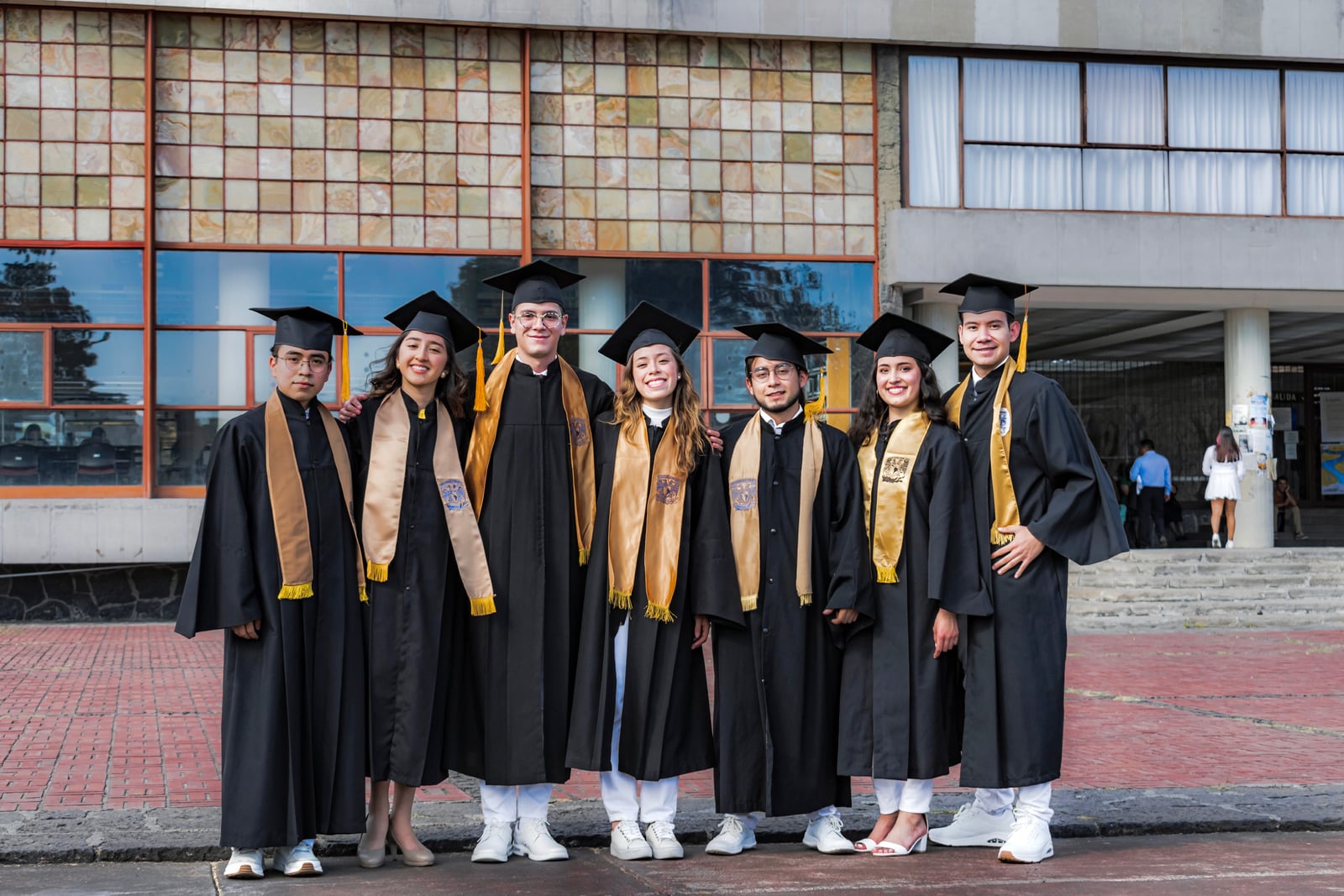
















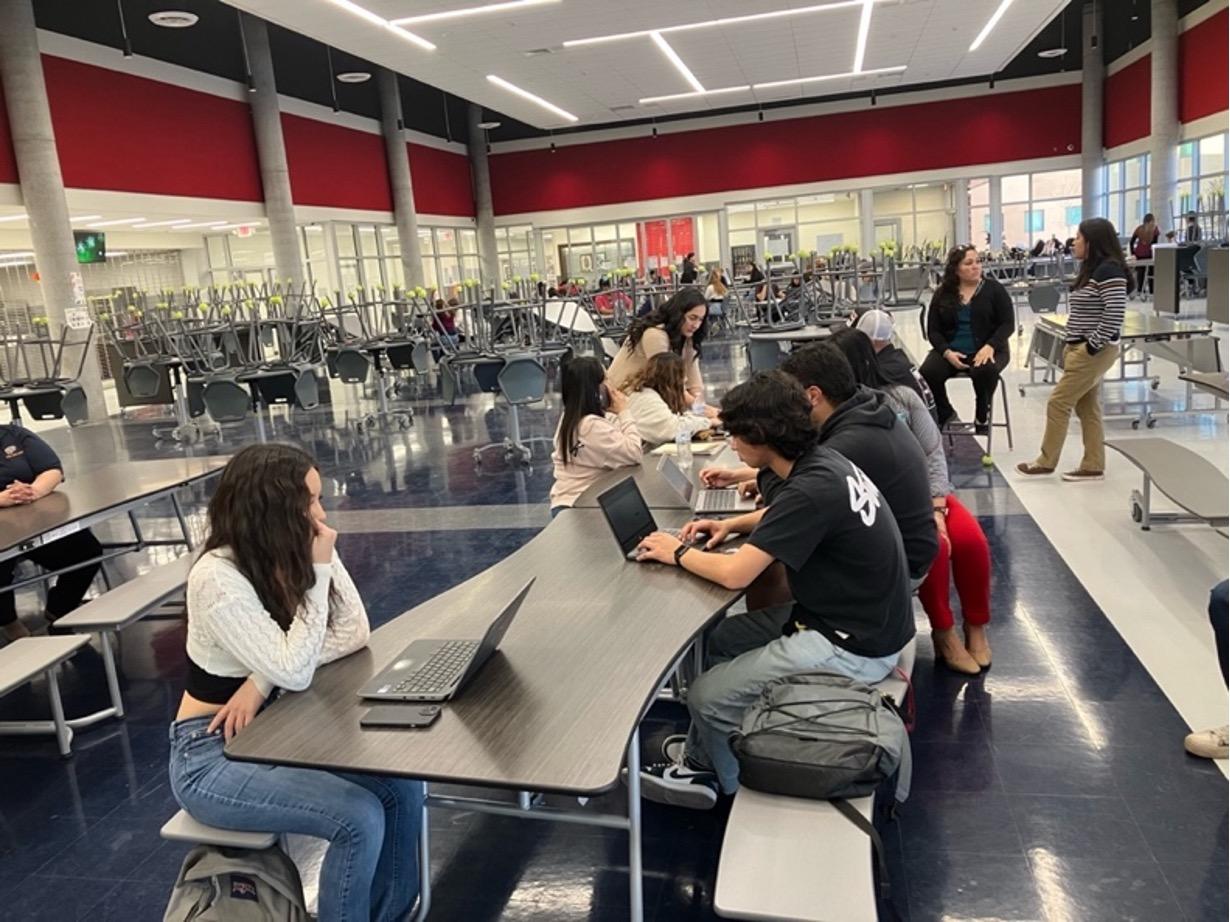
A diverse group of college students walking together and laughing on campus
LNESC
LULAC National Educational Service Centers
InvestmentImpact Guide
2026
College students walking together on campus
Fifty Years. And Counting.

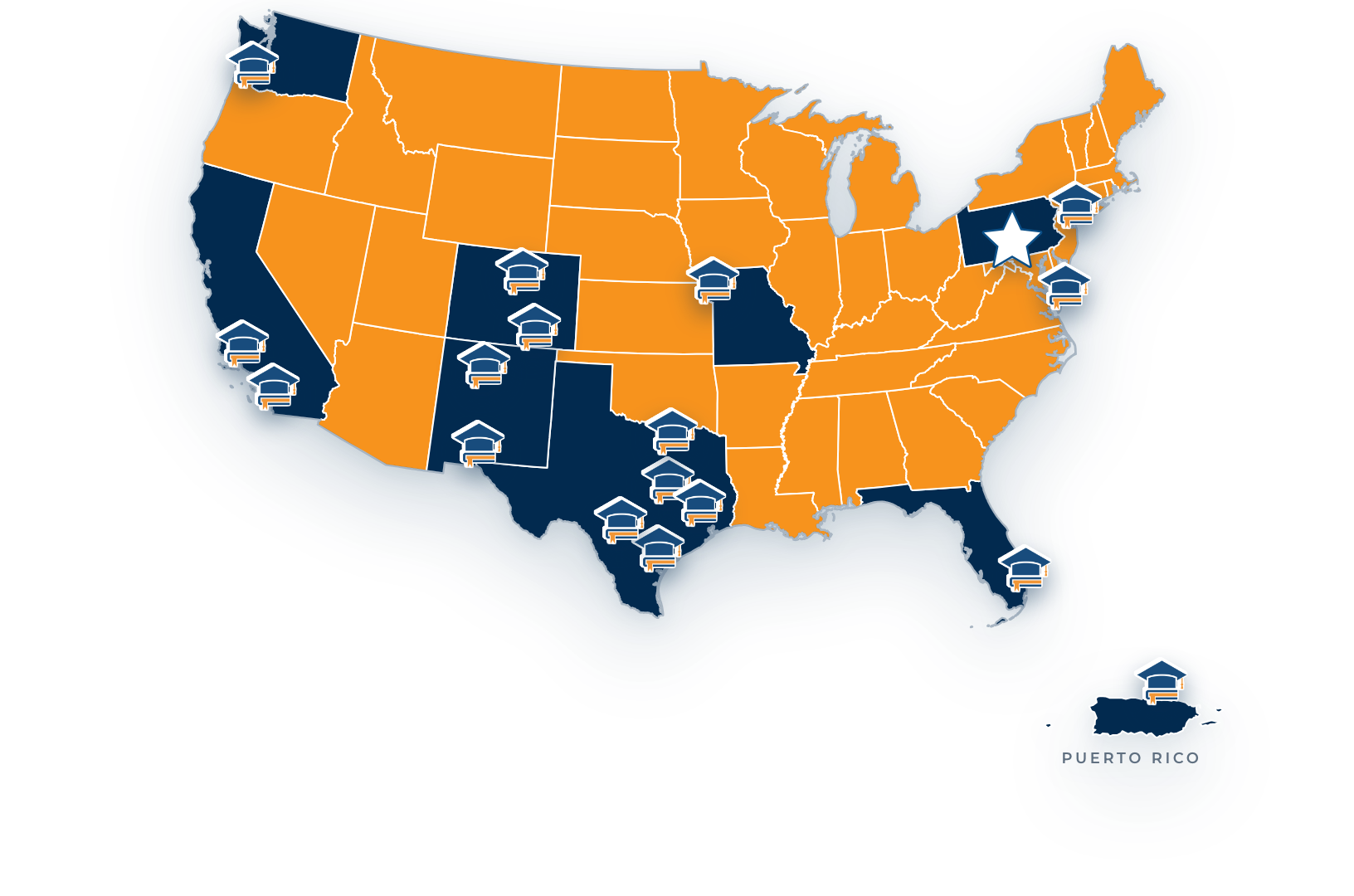
Through our National Office and network of 16 education centers across the United States and Puerto Rico, LNESC produces high-impact results through our education and leadership development programming. This legacy is made possible thanks to our staff, partners, and funders.

We’d like to extend a special thank you to our dedicated staff, educators, LULAC Councils, grassroot partners, corporate sponsors for helping us bring our mission to life for the over 50 years. And counting.

Inspiring Academic Excellence & Empowering Youth
One Student at a Time.
Investment Impact Guide 2026
Inside the Guide
LNESC graduates celebrating together
College access in motion
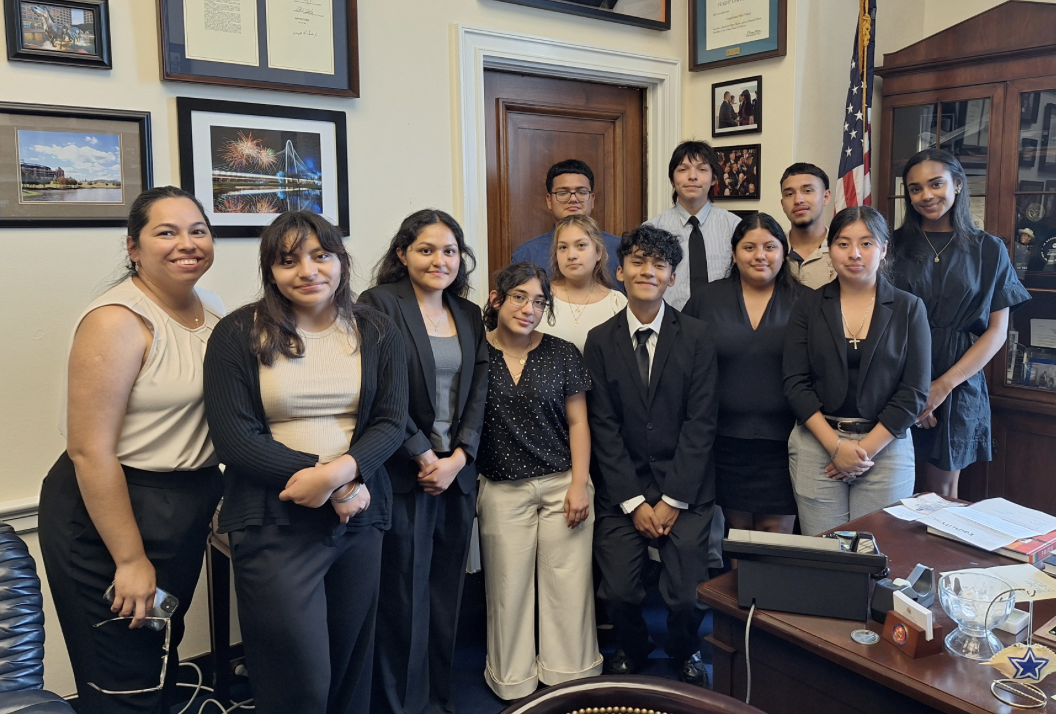
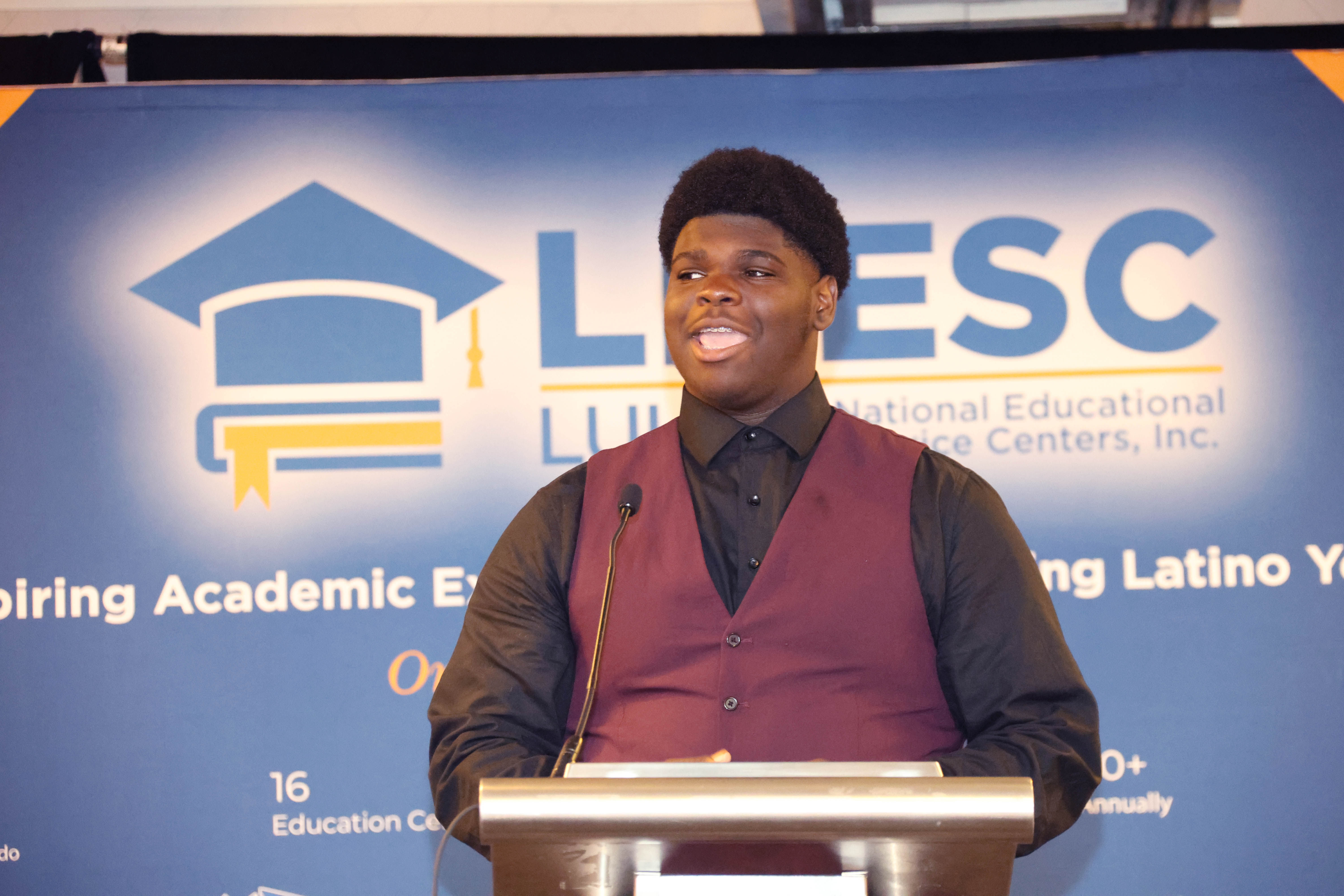
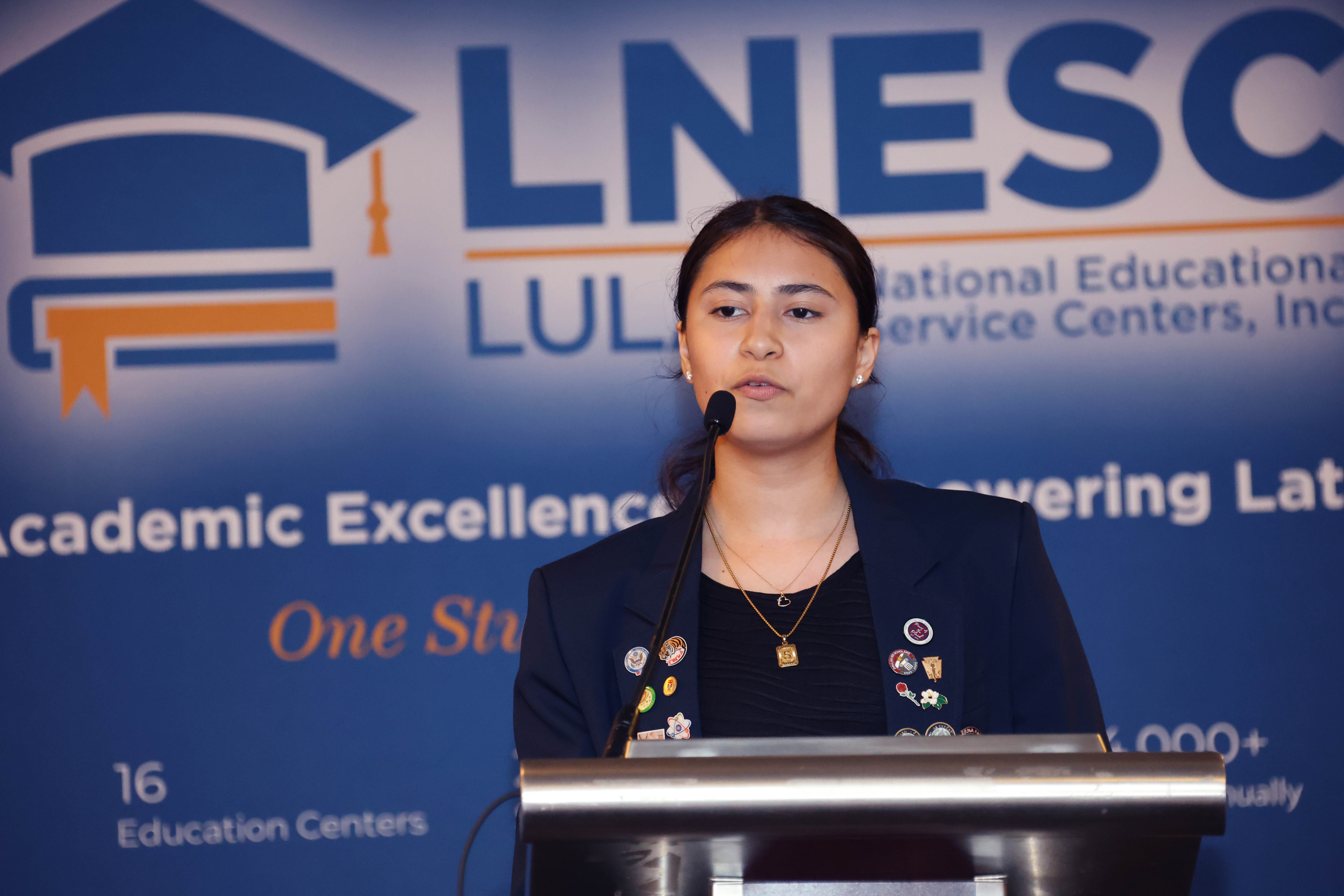
A student speaking at the Washington Youth Leadership Seminar
Leadership built together
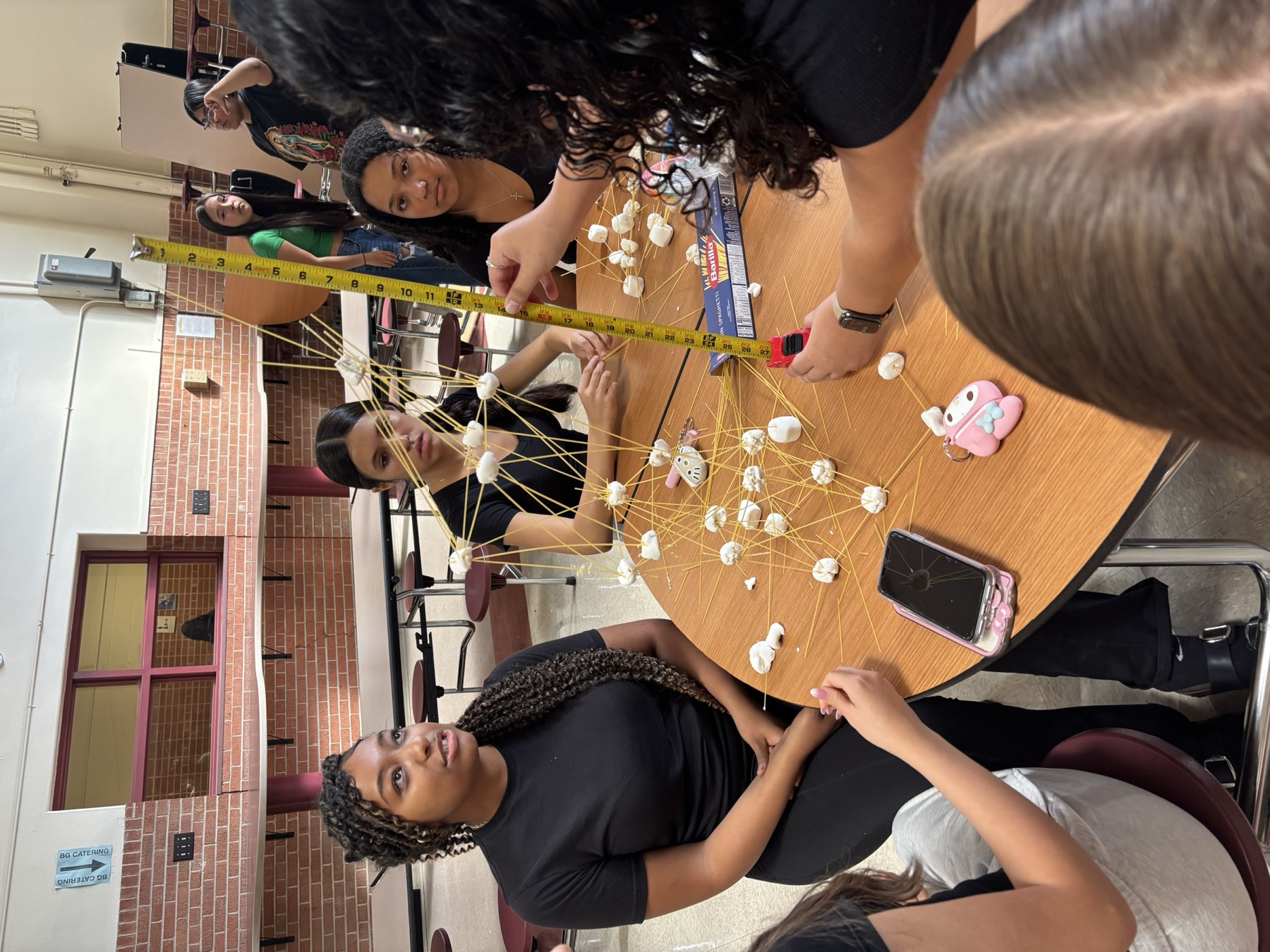
Students participating in a hands-on science activity
Curiosity becomes confidence
01LNESC Overview
About LNESC - History & Background04
Our Mission04
U.S. Education & Opportunity by the Numbers05
Education Centers07
Programs & Locations08
02Education Programs & Services
Federal TRIO Programs - Overview09
Upward Bound10
Upward Bound Math & Science11
Talent Search12
Young Readers13
STEM - Science Corps & STEM Explorers14
Digital Education Initiatives15
Caminos to College & Careers16
College Tours17
03Leadership Programs
Washington Youth Leadership Seminar18
Hispanic Leadership Opportunity Program19
04Scholarship Initiatives & Partnerships
LULAC National Scholarship Fund20
Specialized Scholarships & Resources21
Our Programs22
LNESC Investment Impact Guide03
About LNESC
Fifty years of opportunity

For over fifty years, LNESC has focused on creating a menu of developmentally appropriate educational initiatives. LNESC is uniquely prepared to initiate programs aimed at meeting the academic and social needs of its target communities.

In 1968, a San Francisco LULAC Council developed a financial aid and college admissions outreach program designed to assist academically gifted but disadvantaged, low-income youth in gaining access to college. Based on the success of this program, the LULAC National Office submitted a grant proposal in 1973 to provide these services on a national level. Shortly after, LNESC was established as a separately incorporated entity with its own governing board and independent control of its programs.

Through our education and technology centers nationwide, LNESC has served over 635,000 students, sent 161,000 students on to college, and awarded over $32 million in scholarships, made possible by a network of dedicated field staff, top-notch teachers, over 90 school partners, and the support of LULAC.

LNESC continues to provide high-quality education and leadership programming in cities throughout the U.S. and Puerto Rico. With the support of corporate, government, and community partners, LNESC will continue to do so for another 50 years and beyond.

Our Mission

The mission of the LULAC National Educational Service Centers is to advance educational excellence and leadership development programs to create lifelong learners and leaders in communities with limited opportunities. We build our community's strength by empowering students to reach their full potential to achieve their academic and professional goals.

50+
Years of Service
635K+
Students Served
161K+
Sent to College
$32M
In Scholarships
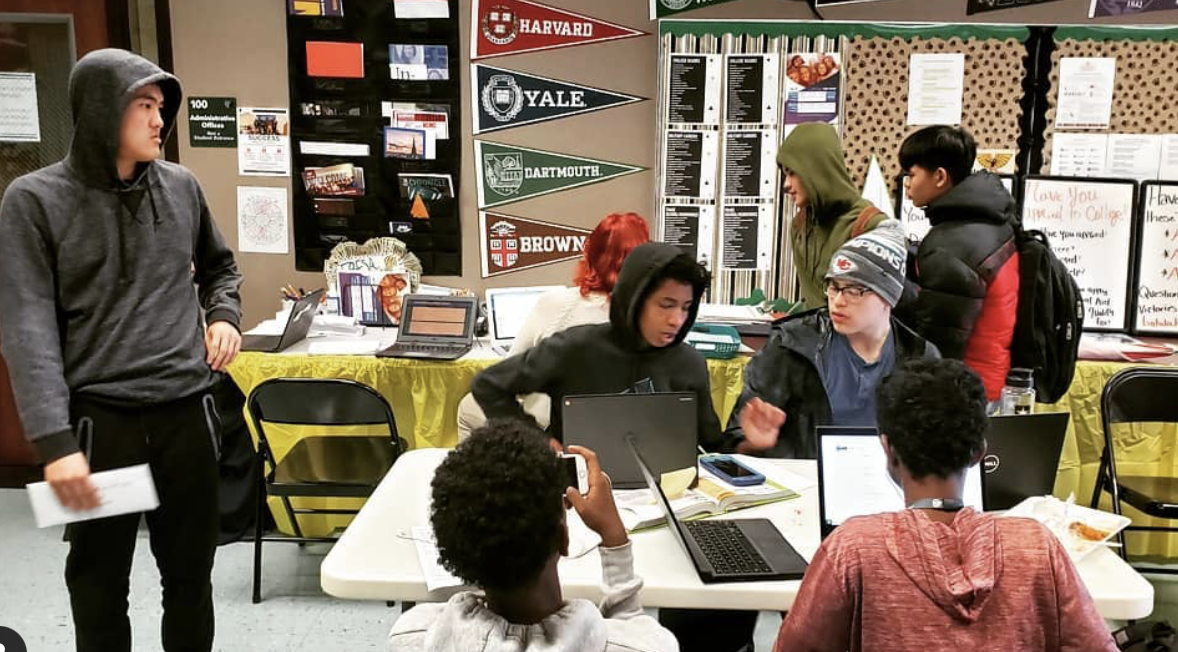
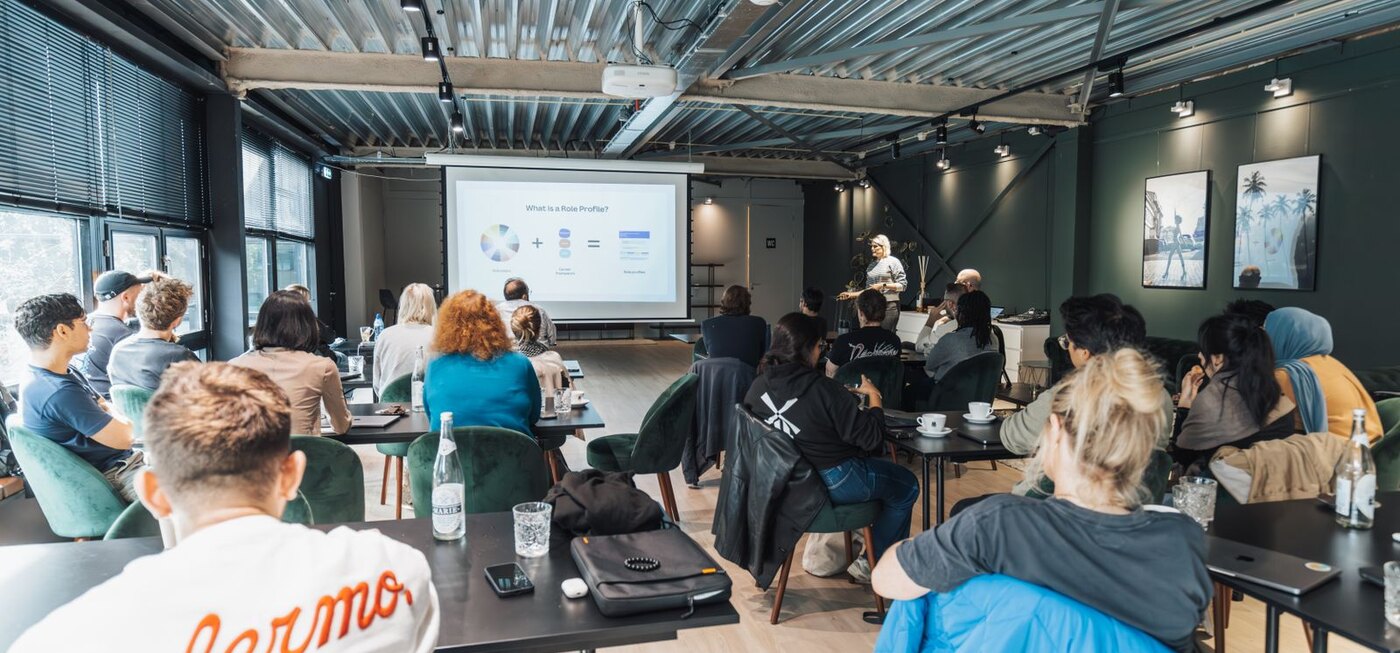
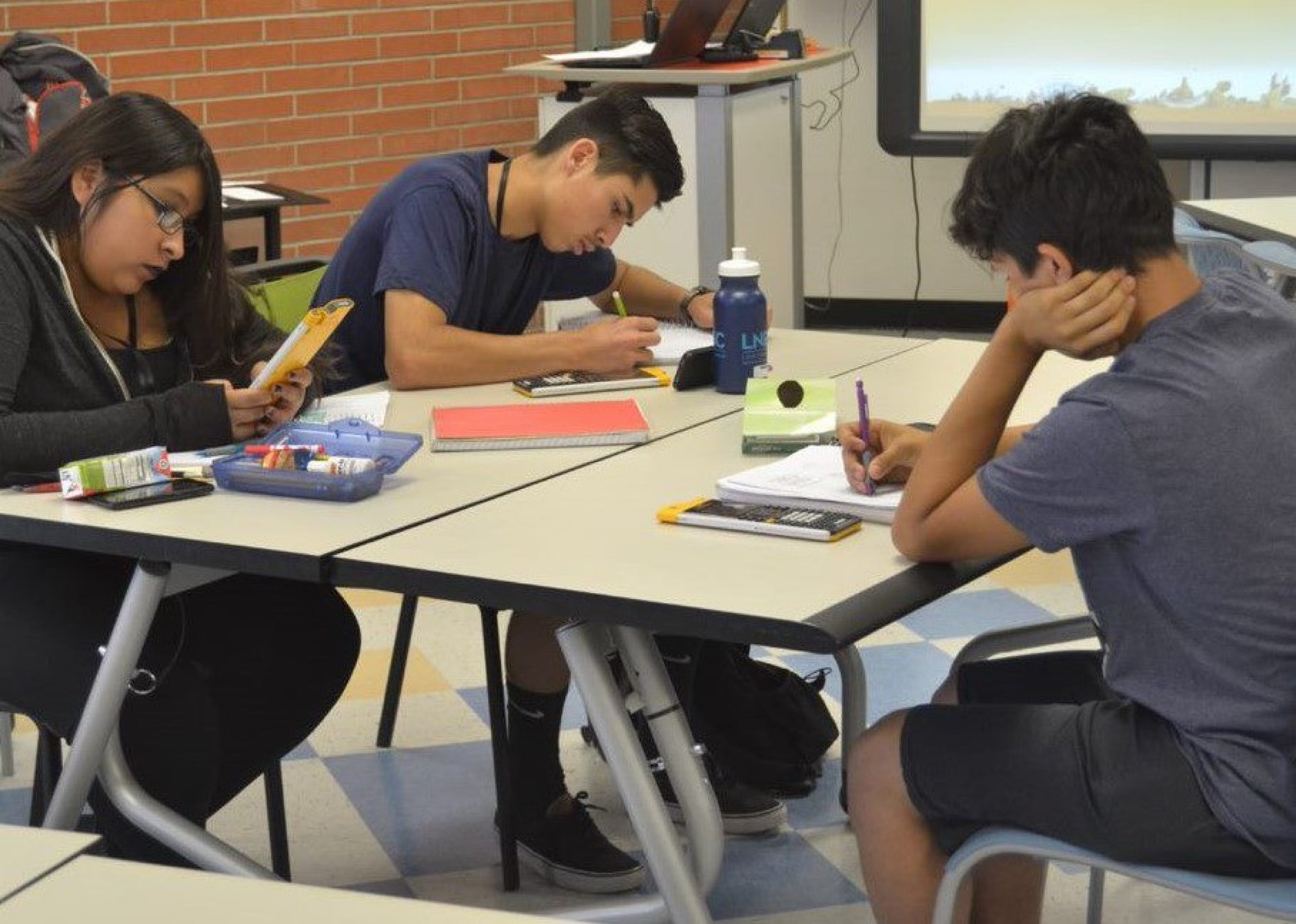
LNESC Upward Bound graduates celebrating with their diplomas LNESC students studying together A student speaking at an LNESC leadership event Students taking part in an LNESC STEM activity
LNESC Investment Impact Guide04
The National Landscape

U.S. Education & Opportunity by the Numbers

Educational outcomes and economic opportunity vary widely from one community to the next. The figures below provide a snapshot on where gaps persist across the nation. These data-driven insights help us understand why investment in education is an investment in our community and the future of America's workforce.

2045
Projected year in which no single racial or ethnic group makes up a majority of the U.S. population.U.S. Census projections
1out of2
By 2032, people of color will be a majority of America's working class: the workers without a four-year degree.Economic Policy Institute, 2016
52.7%
Of Americans under 18 already belong to a racial or ethnic minority.2020 Census · each figure = 10%

Bachelor's Degree or Higher, Adults 25+ A 41-point spread separates the top and bottom of the same country.

Asian 57.8% White (non-Hispanic) 40.0% Two or More Races 28.6% Black or African American 26.2% Hispanic or Latino 20.8% Native Hawaiian / Pacific Islander 19.1% American Indian / Alaska Native 16.8%
Dashed line marks the national benchmark: 36.2% of all U.S. adults 25+ hold a bachelor's degree. Scaled to a 60% axis. Source: U.S. Census Bureau, American Community Survey, Table S1501, 2023.

Status Dropout RateAges 16-24, out of school without a credential

Asian1.9% White4.3% Black5.7% Hispanic7.9% Amer. Indian / AK Native9.9%
Scaled to a 10% axis. Source: NCES, Condition of Education, 2022.

Immediate College EnrollmentRecent high-school completers enrolled that fall

74%
Asian
64%
White
62%
U.S. overall
61%
Black
58%
Hispanic

16 points separate the top and bottom group at the door of college. By the time degrees are counted, that gap has widened to 41 points.

Source: NCES, 2022. Comparison drawn against the attainment chart above.
LNESC students arriving for a campus experience
LNESC students completing a hands-on STEM activity
LNESC students celebrating academic achievement
LNESC Investment Impact Guide
05
The National Landscape

Opportunity & the Future Workforce

Who Fills America's Skilled Professions Each group's share of the profession, measured against its share of the total labor force.

Profession
Whitebaseline 76%
Hispanicbaseline 19%
Blackbaseline 13%
Asianbaseline 7%
Registered nursesBLS, 2023
66.1%under
9.0%under
11.3%under
9.0%over
K-12 public school teachersNCES NTPS, 2020-21
80%over
9%under
6%under
2%under
Physicians & surgeonsAAMC, 2023
63.9%under
6.9%under
5.7%under
20.6%over
The dashed tick is that group's share of the total labor force - the line a bar must reach to be proportionally represented. All meters scaled to a common 85% axis. Hispanic origin cross-cuts racial categories, so shares do not sum to 100%.

In Management & Professional RolesShare of each group's employed workers · BLS, 2023

59%
Asian
44%
White
36%
Black
26%
Hispanic

A Hispanic worker is less than half as likely as an Asian worker to hold a management or professional role.

Management, professional & related occupations. Source: U.S. Bureau of Labor Statistics, 2023.

Poverty Rate by GroupOfficial Poverty Measure · Census, 2024

Asian7.5% White7.6% Hispanic15.0% Black18.4% Amer. Indian / AK Native19.3%
Scaled to a 20% axis. Source: U.S. Census Bureau, P60-287.
5.25M
More workers with education and training beyond high school the U.S. will need by 2032. 4.5 million of them will need a bachelor's degree.Georgetown University Center on Education and the Workforce, Falling Behind, 2025
~54%
Of U.S. undergraduates are the first in their family to pursue a bachelor's degree.NCES, 2020
72%
Of U.S. jobs will require education beyond high school by 2031.Georgetown University Center on Education and the Workforce

Sustained investment in college access can close this gap.Talent is everywhere. Opportunity must be, too.

Sources: U.S. Census Bureau (CPS & ACS educational attainment, 2022-2024; Poverty in the United States 2024, P60-287; National Population Projections). National Center for Education Statistics, Condition of Education 2022 and NTPS 2020-21. U.S. Bureau of Labor Statistics, Labor Force Characteristics by Race and Ethnicity 2023 and Employment Projections 2023-33. Association of American Medical Colleges, 2023. Figures reflect the most recent data available at publication.
LNESC Investment Impact Guide
06
01   About LNESC · Where We Work
LNESC Centers
Our education centers are at the forefront of helping disadvantaged students across the United States and Puerto Rico. Although each one is uniquely operated, all locations host Department of Education TRIO Programs, specifically Upward Bound, Upward Bound Math & Science, and/or Talent Search. From there, centers offer an array of programs, depending on availability and partnership focus. These programs include a range of educational resources such as college access, literacy, science, technology, digital education, and leadership development.
LNESC Investment Impact Guide07
01Where We Work

Programs & Locations

Program reach and education center locations

One network.
Many pathways.

LNESC has incorporated program models that service disadvantaged students at all stages of educational development. LNESC develops and delivers a range of services at the elementary, middle, and high school levels. Through scholarship funding, academic programming, and assistance through the college application process, we empower youth to overcome barriers to success and take control of their educational journeys.

With the right tools and guidance, we help youth join the generation of rising leaders and innovators that are the future of our community and our country.

Upward BoundAlbuquerque, NM; Bayamon, PR; Colorado, CO; Corpus Christi, TX; Kansas City, MO; Miami, FL; Oxnard, CA; Philadelphia, PA; San Antonio, TX; San Diego, CA; Vancouver, WA
Upward Bound Math & ScienceColorado Springs, CO; Corpus Christi, TX; Dallas, TX; Houston, TX; Philadelphia, PA; San Antonio, TX
Talent SearchAustin, TX; Corpus Christi, TX; El Paso, TX; Houston, TX; Philadelphia, PA
Science Corps and STEM ExplorersAlbuquerque, NM; Dallas, TX; Houston, TX
Digital EducationDallas, TX; Houston, TX; Kansas City, MO; Oxnard, CA; San Antonio, TX; Vancouver, WA
College ToursCorpus Christi, TX; Dallas, TX; Houston, TX
Caminos to College and CareersWashington, DC
Young ReadersCincinnati, OH
Washington Youth Leadership SeminarArkansas; California; Colorado; Florida; Iowa; New Mexico; Pennsylvania; Virginia; Texas; Washington; Washington, DC
Hispanic Leadership Opportunities ProgramKansas City, MO
LULAC National Scholarship FundArkansas; California; Florida; Illinois; Iowa; Kansas; Massachusetts; Ohio; Pennsylvania; Texas; Wisconsin; Washington, DC
LNESC · Investment Impact Guide 2026
08
02Education Programs & Services

LNESC Education
Program and Services

Federal TRIO Programs
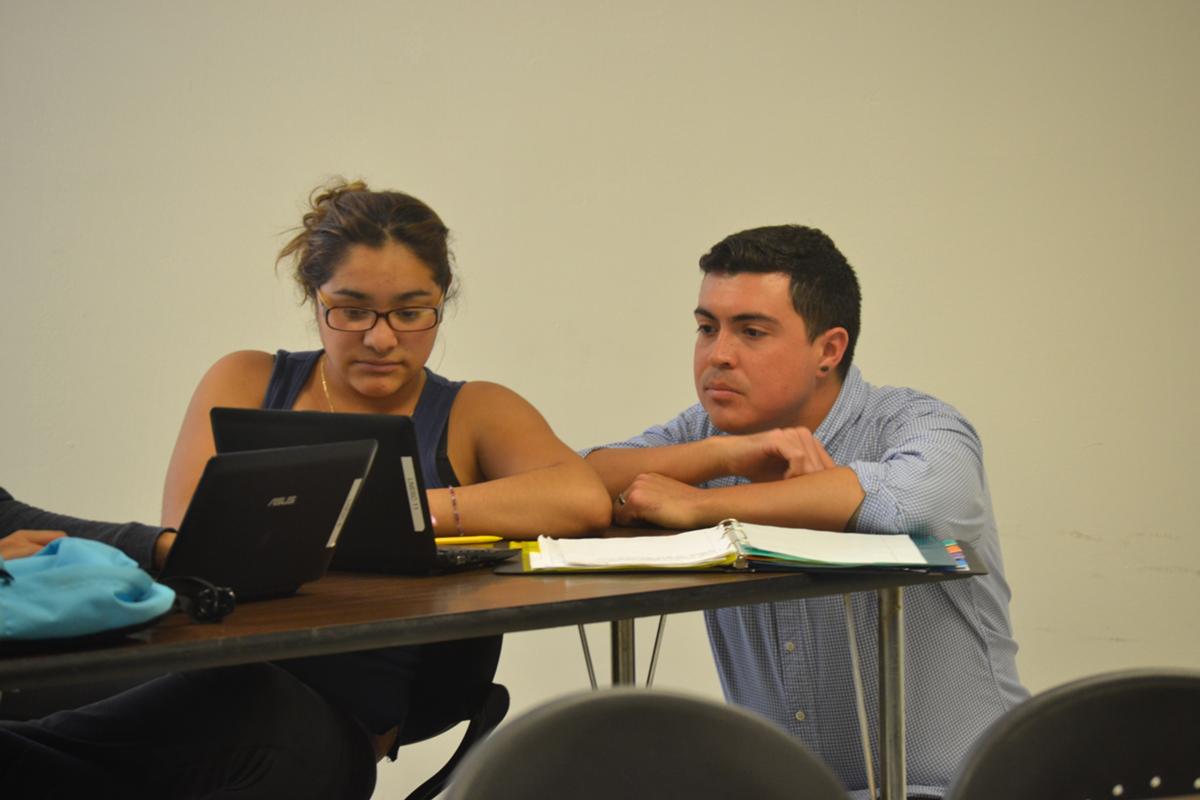
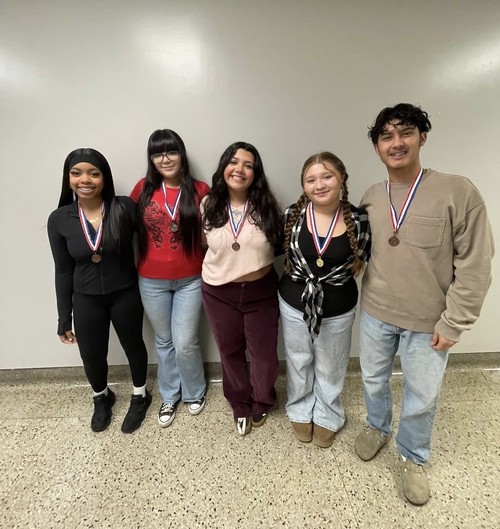
Students and families attending an LNESC financial-aid eventAn LNESC student receiving academic supportTalent Search students participating in an academic program

Through the Department of Education Federal TRIO Programs (TRIO), LNESC is able to operate the Upward Bound, Upward Bound Math & Science, and Talent Search programs. TRIO programs are Federal outreach and student services programs designed to identify and provide services for individuals from disadvantaged backgrounds.

The TRIO programs help first-generation, low-income students overcome social, cultural, and academic barriers to succeed in higher education. By providing direct services and individually focused and intensive programming geared towards helping students navigate the college admissions and financial aid process, TRIO programs assist students in overcoming the obstacles they face as the first in their families to attend and graduate from college.
Program Impact

1979
LNESC has hosted TRIO programs since 1979
436,613
participants served since 1979
30
TRIO programs in 8 U.S. states, including Puerto Rico
161K
students sent on to college
LNESC · Investment Impact Guide 2026
09
02Federal TRIO Programs

Upward Bound

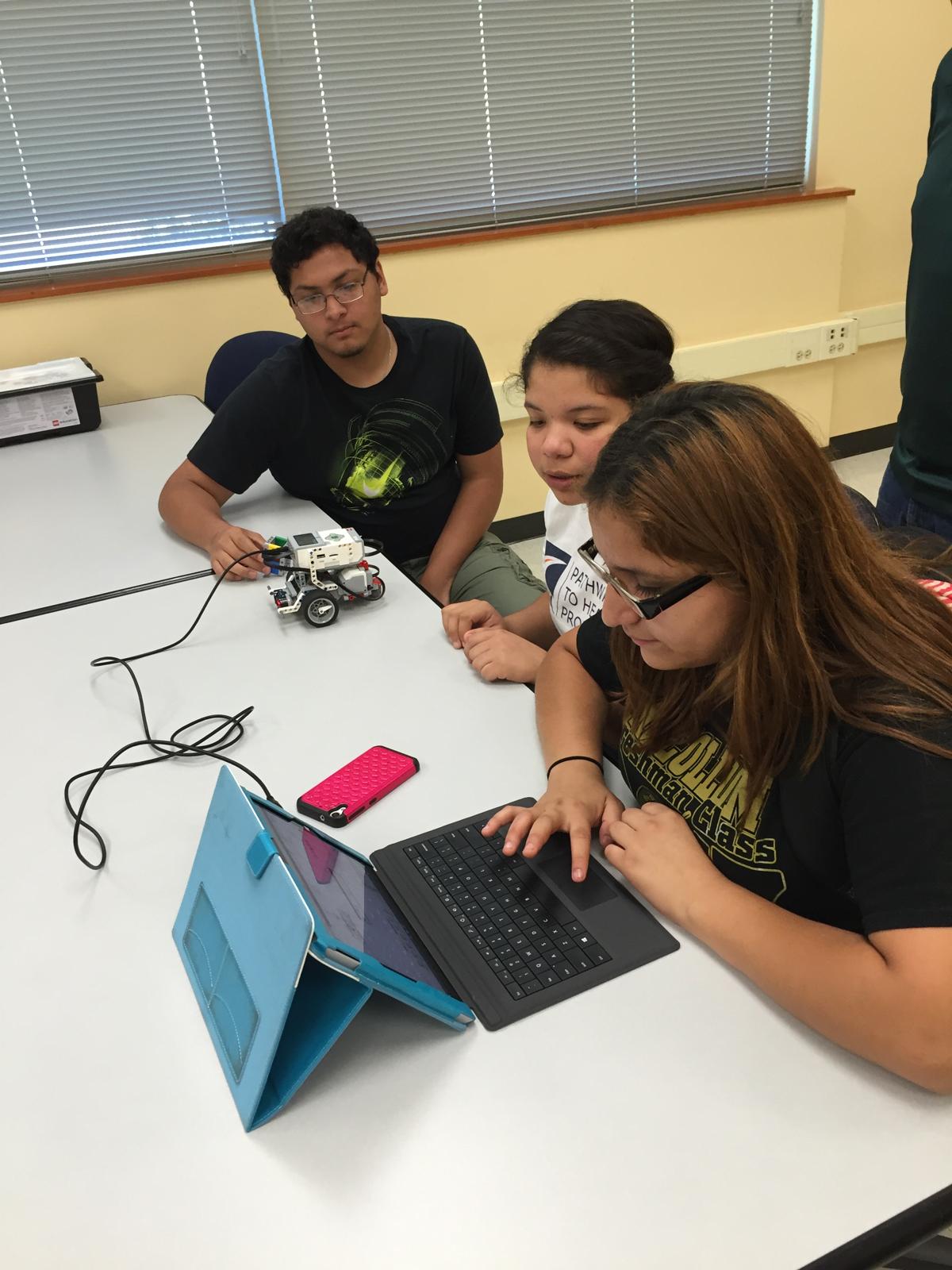
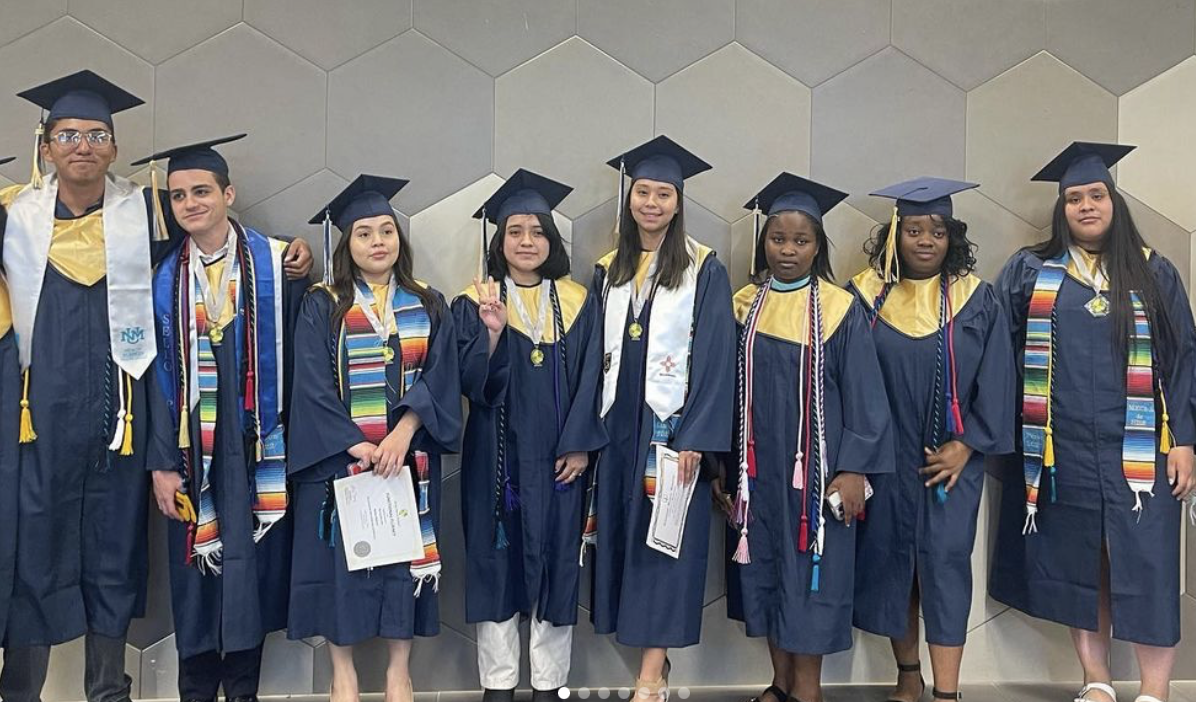
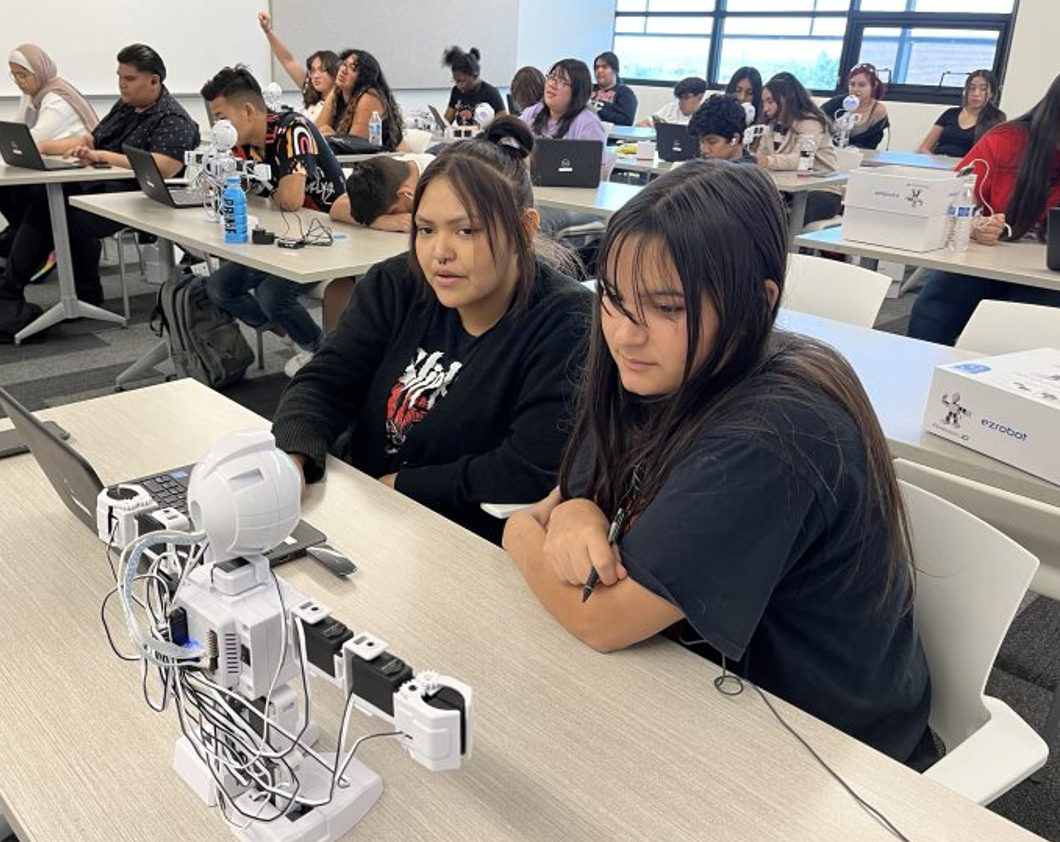
Upward Bound graduates celebrating togetherUpward Bound students building and testing robotsUpward Bound students studying together
Tutoring · advisement · mentoring · college preparation

LNESC Upward Bound is a federally funded TRiO program providing fundamental support to participants in their preparation for college entrance. It provides opportunities for students to succeed in their pre-college performance and ultimately in their higher education pursuits. The goal is to increase the rate at which participants complete secondary education and enroll in and graduate from institutions of post-secondary education.

Upward Bound projects offer tutoring, advisement, mentoring, and supplemental instruction. The program is specially designed for high school students from low-income and or first-generation families (neither parent holds a bachelor’s degree) and other disconnected youth.

12,260
participants served since 1997
83%
cumulative GPA of 2.5 or higher
98%
promoted or graduated
90%
enrolled post-secondary

Program Locations

  • Albuquerque, NM (5)
  • Bayamon, PR
  • Colorado Springs, CO
  • Corpus Christi, TX
  • Dallas, TX (2)
  • Kansas City, MO
  • Miami, FL
  • Oxnard, CA
  • Philadelphia, PA
  • San Antonio, TX
  • San Diego, CA
  • Vancouver, WA

Our Impact

  • Average of 60 participants per program cycle.
  • Academic Performance: 83% of participants achieved a cumulative GPA of 2.5 or higher (4.0 scale) the academic school year.
  • Secondary School Retention & Graduation: 98% of participants were promoted to the next grade level or graduated from high school.
  • Post-secondary Enrollment: 90% of participants enrolled in a post-secondary institution.

Student Voice

LNESC Upward Bound has helped me maintain high grades and different opportunities to learn. They’ve also taught me different life skills. I learned how to write a resume and cover letter for the first time. The Saturday Academies cover issues facing the world or just everyday issues we face and how to cope.
Andres, Student at Valley High School, TRIO Upward Bound Participant
LNESC · Investment Impact Guide 2026
10
02Federal TRIO Programs

Upward Bound Math & Science

Students in a math and science program
Building skill, confidence, and a future in STEM

LNESC Upward Bound Math & Science is a federally funded TRIO program focused on recruiting students that have an interest in math and science. The program is designed to strengthen the math and science skills of participating students with a goal to help them recognize and develop their potential to excel in these fiends. The program encourages participants to pursue post-secondary degrees and ultimately careers in math and science professions.

3,631
participants served since 2006
90%
cumulative GPA of 2.5 or higher
98%
promoted or graduated
98%
enrolled post-secondary

Program Locations

  • Colorado Springs, CO
  • Corpus Christi, TX
  • Dallas, TX
  • Houston, TX (2)
  • Philadelphia, PA
  • San Antonio, TX

Our Impact

  • Average of 60 participants per program cycle.
  • Academic Performance: 90% of participants achieved a cumulative GPA of 2.5 or higher (4.0 scale) the academic school year.
  • Secondary School Retention & Graduation: 98% of participants were promoted to the next grade level or graduated from high school.
  • Post-secondary Enrollment: 98% of participants enrolled in a post-secondary institution.

Student Voice

As a senior, the Upward Bound program is where I can get my work done from other classes. The tutors are amazing at helping out with subjects I don’t understand very well. Along with that, they have been a huge help with applying to universities and scholarships. Without their help, I wouldn’t have known what schools to apply to and which scholarships to apply to. They have a very friendly environment and informative workshops that they set up that I enjoy attending.
Dariela, LNESC San Diego, TRIO Upward Bound Math and Science Participant
LNESC · Investment Impact Guide 2026
11
02Federal TRIO Programs

Talent Search

Talent Search students meeting civic leaders
Academic · career · financial counseling

LNESC Talent Search is a federally funded TRIO program that identifies and assists individuals from disadvantaged backgrounds who have the potential to succeed in higher education. The program provides academic, career, and financial counseling to its participants with a goal to increase the number of youth from disadvantaged backgrounds who complete high school and enroll in and complete their post-secondary education.

The program also encourages students who have not completed education programs at the secondary or post-secondary level to enter or re-enter and complete post-secondary education.

421,015
participants served since 1979
99%
promoted to next grade
98%
graduated high school
72%
enrolled post-secondary

Program Locations

  • Austin, TX
  • Corpus Christi, TX (2)
  • El Paso, TX
  • Houston, TX
  • Philadelphia, PA

Our Impact

  • Average of 500 participants per program cycle.
  • Secondary School Retention: 99% of participants were promoted to the next grade level.
  • Graduation: 98% of participants graduated from high school.
  • Post-secondary Enrollment: 72% of participants enrolled in a post-secondary institution.

Student Voice

TRIO Talent Search has helped me with college prep, scholarships, and career advice. They provided workshops on college applications, financial aid, scholarship searches, and career planning. I loved the field trips we went on, like to Texas State, the Capitol, and St. Edward’s. This program gave me a sense of fulfillment and helped me keep going through high school. I am grateful to TRIO Talent Search for helping me close this chapter of my life and opening up the next.
Alexis, LNESC Austin, TRIO Talent Search Participant
LNESC · Investment Impact Guide 2026
12
02Literacy Initiative

Young Readers

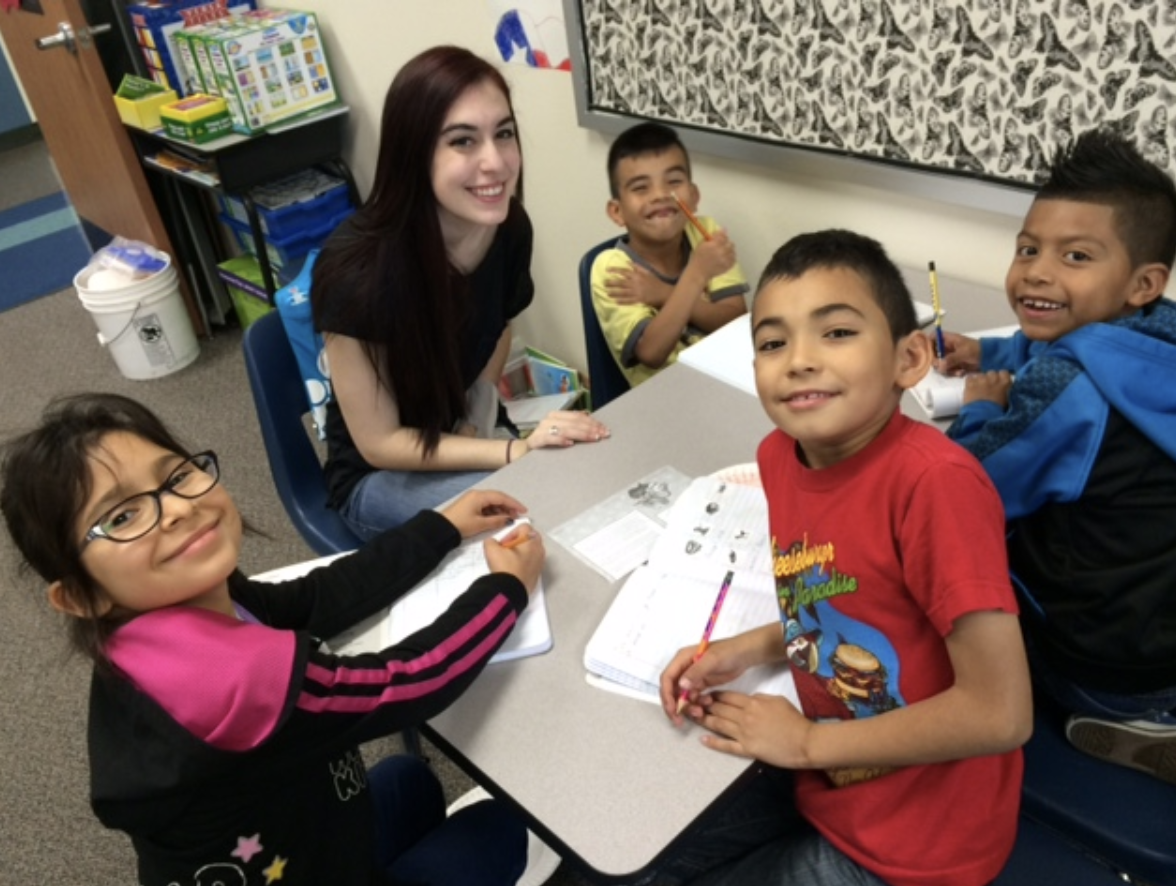
Young Readers students learning together
Early literacy · family engagement · confidence

The LNESC Young Readers program was launched as a national initiative in 1986 to improve reading skills among kindergarten through second-grade students. Since then, it has successfully evolved into an intervention for raising the reading levels of academically challenged children, while also drawing parents into a literacy development framework that benefits their entire family.

The program is highly interactive and family-oriented offered during the academic school year, designed to strengthen literacy and instill a love of reading at an early age. Program participants include students who are struggling with reading and writing, especially those whom teachers believe can benefit from its structure and support. In addition to the increase in self-confidence, Young Readers has been improving the communication skills, writing skills and comprehension levels of K-2nd graders across the nation for 40 years.

9,814
participants served since 1993
87%
of parents saw improved reading
100%
improved between evaluations
94%
feel happy about teachers

Program Locations

  • Cincinnati, OH (2 Programs)

Our Impact

  • Average of 25 - 30 participants per program cycle.
  • 87% of parents surveyed reported that they observed an improvement in their child’s reading abilities.
  • 94% of students surveyed reported that when they think of the teachers of Young Readers, they feel happy.
  • 100% of students showed improvement between their first and last reading evaluations.
Partnership Levels
$20,000 – $40,000

Student Voice

I like young readers because it helped me to be a strong reader and I learned to understand math equations. I liked working with the teachers.
Djibril, 1st Grade Student at Carthage School, Cincinnati, OH

Teacher Voice

Young readers was very beneficial to my Kindergarten classroom. The students that attended this program excelled in their letters, sounds, sounding out words, and even their handwriting.
E. Wethington, Kindergarten Teacher at Carthage School, Cincinnati, OH
LNESC · Investment Impact Guide 2026
13
02STEM Initiatives

Science Corps & STEM Explorers

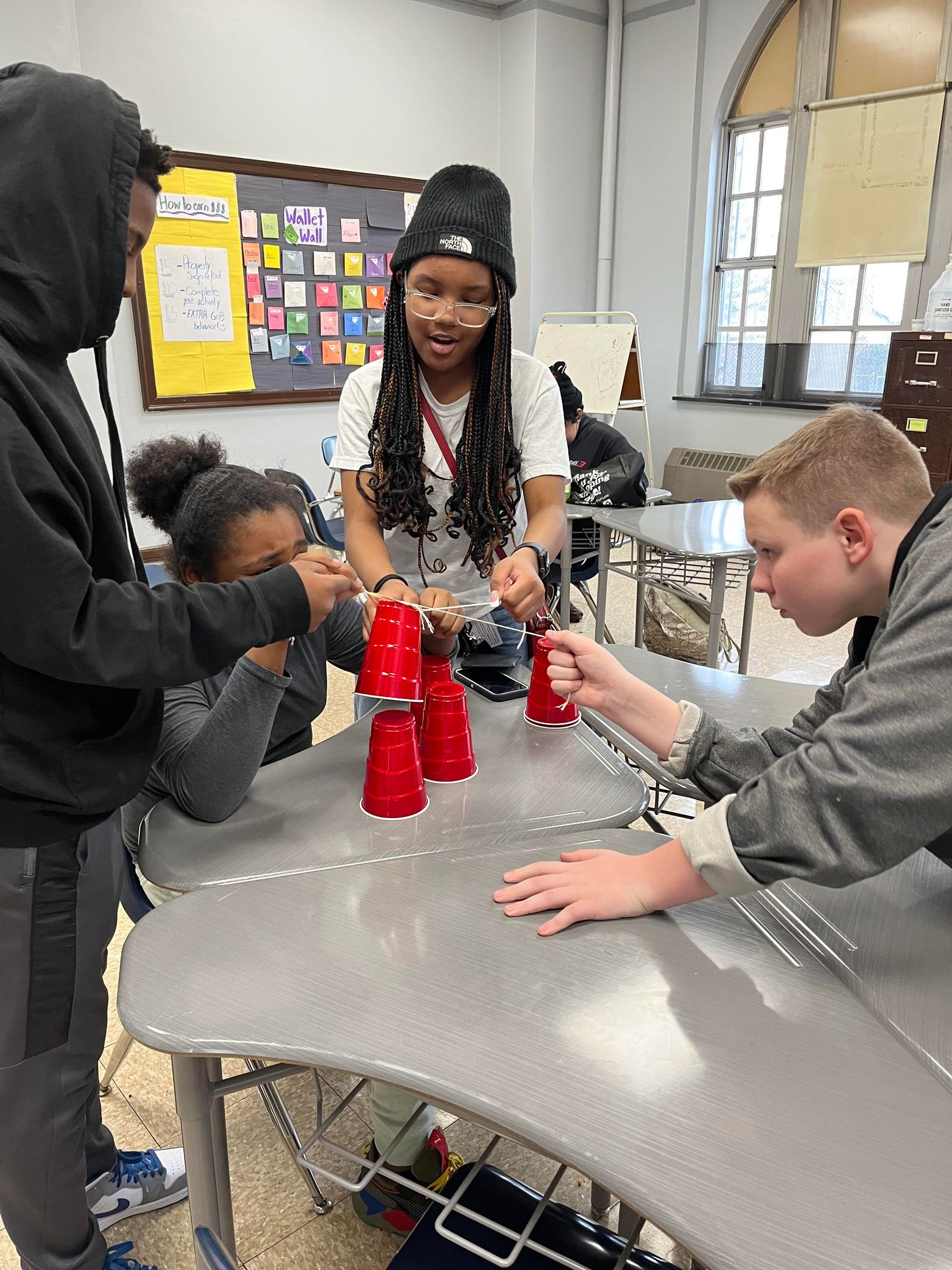
Students collaborating in a science and leadership workshop
Hands-on inquiry · real-world applications · STEM careers

LNESC STEM-Based initiatives are after-school enrichment programs designed to inspire middle and high school students to increase their interest in the fields of science, technology, engineering, and math. Through hands-on, inquiry-based learning experiences, the programs introduce participants to STEM practices and real-world applications, while connecting students to professionals working in those fields.

LNESC STEM-Based initiatives include Science Corps and STEM Explorers. The LNESC Science Corps program is focused on middle school students, exposing them to STEM practices meant to increase student interest. STEM Explorers recruits high school students to foster a deeper interest in STEM education and careers.

3,956
students served since 2011
100%
educators saw problem-solving gains
25-30
participants per cycle
2
program cities

Program Locations

  • Houston, TX
  • Dallas, TX
  • Average of 25 - 30 participants per program cycle.
  • 100% of Science Corps educators surveyed indicated that students made significant gains in problem solving and critical thinking skills as a direct result of the program.
  • Past curriculums include an exciting range of topics such as nanotechnology, physics, environmental science, energy and sustainability.
  • Teachers certified to lead STEM workshops facilitate the program.
Partnership Levels
$30,000 – $45,000

Student Voice

This is my second year of going to the Shell Science Program, and what I like about the Shell Science Program is the constant fun activities we set out to do. For example, we made this layer potion like experiment to show a combination of mixtures together. And what I found most exciting about the program are the field trips we get to do by the end of the week. This program allowed me to socialize during the summer while doing fun activities that incorporated learning new skills that may help me into the future.
Alyssa, Houston, Texas, Participant in Science Corps program

Student Voice

What I found most exciting about this program is talking to other kids and working with others on amazing projects like using a potato as a battery to turn on a clock with an electrical circuit. The projects are so interesting, I had fun, learned, and got proud to make a race. It’s cool because I made something with my hands that flies. I decided to be in the program because it’s fun. It is fun for me to go to people that have the same interests as me and to enjoy the activities that I do every day in this program.
Gael Hernandez, Houston, Texas, Participant in Science Corps program
LNESC · Investment Impact Guide 2026
14
02Digital Literacy

Digital Education Initiatives

Students taking part in an LNESC digital education workshop
PUENTES · Bridging people and technology

LNESC digital education initiatives work to bridge the gap between people and technology by hosting virtual and in-person workshops. These sessions are designed to build digital literacy skills, helping participants understand how to navigate their digital devices and the internet, and how to access digital learning platforms. By creating a supportive learning environment, LNESC empowers individuals of all ages and backgrounds to gain confidence in using technology in their daily lives.

Through digital education resources, we also introduce participants to emerging tools and platforms, making technology less intimidating and more practical. Whether it’s learning how to communicate online, manage digital information, or explore career opportunities in a tech-driven world, LNESC equips learners with skills that promote independence and inclusion. Our efforts center on bridging the digital divide through increasing awareness and offering learning opportunities to the communities we serve.

4,599
participants served since 2020
30-60
participants per session
13
program cities
10
families per PUENTES cohort

Program Locations

  • Albuquerque, NM
  • Austin, TX
  • Compton, CA
  • Dallas, TX
  • El Paso, TX
  • Houston, TX
  • Oxnard, CA
  • San Diego, CA
  • Miami, FL
  • San Antonio, TX
  • Topeka, MO
  • Vancouver, WA
  • Washington, DC
  • PUENTES average is 10 families per program cohort.
  • Digital education workshops average 30 –60 participants per session.
  • 4,599 participants served since 2020.
  • CONEXIONES with Spectrum — 2020: 60 · 2021: 120 · 2022: 74 · 2024: 21

Student Voice

During the AT&T workshop, my teacher Mr. Velasquez helped me understand the layout and function of the AI website and allowed me to understand how the AI functions and works. Thanks to the workshop, I am now able to use AI more responsibly and incorporate it into my school and everyday life in a useful way. The workshop also allowed me to get a better understanding of how to tell if AI is used within an image or writing, in order to distinguish AI from reality.
Jaylynn, LNESC San Antonio (UBMS), Participant in AT&T Digital Education session
LNESC · Investment Impact Guide 2026
15
02Workshop Series

Caminos to College & Careers

Caminos workshop participants
Educational & leadership workshops · virtual and in person

Caminos to College and Careers is a series of educational and leadership virtual workshops to prepare students for higher education opportunities to provide pathways to careers. The workshops are led by career professionals and experienced presenters and are designed to engage students in relevant topics that support personal and professional growth.

LNESC identifies and invites a diverse group of professionals from throughout the country to participate and engage with students in large and small group virtual settings as moderators, presenters and panelists. The workshops are hosted on virtual platforms, and as appropriate, hosted as in-person sessions.

458
participants served since 2021
30-60
participants per workshop
National
virtual and in person
DC
program base

Delivery

  • National, virtual and in person
  • Based in Washington, DC

Our Impact

  • Virtual workshops average 30 –60 participants.
  • 458 participants served since 2021.

Student Voice

What I found most useful about the presentation were the student resources and budgeting. I feel like I have more knowledge on how I can use and find all the resources that are provided on campus and how I can use these resources to my advantage. As for budgeting, I felt that they gave great tips onto how to manage money; college is very expensive so the tips they gave I can see myself using in the near future.
Mariana, Caminos Participant
LNESC · Investment Impact Guide 2026
16
02College Access

College Tours

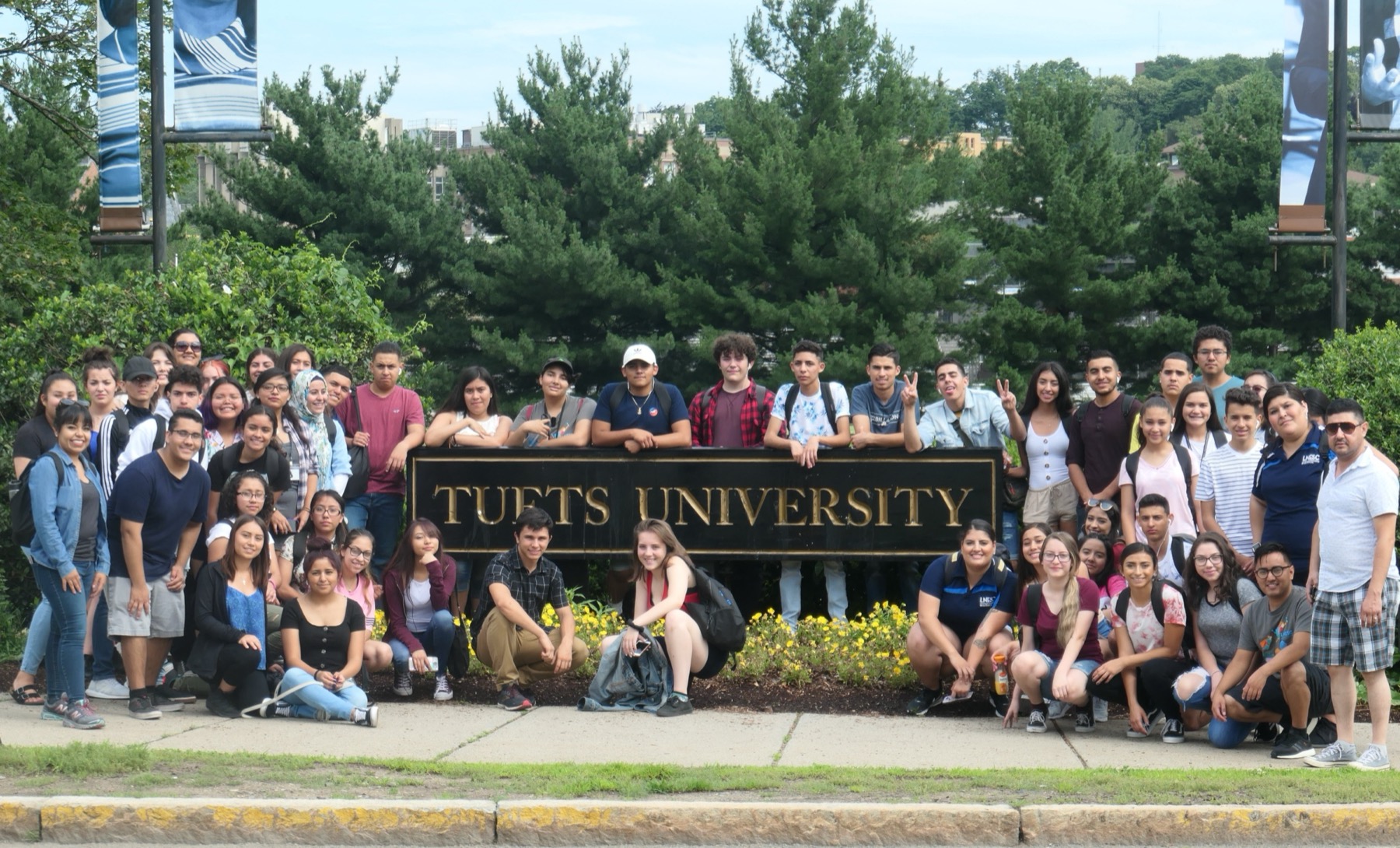
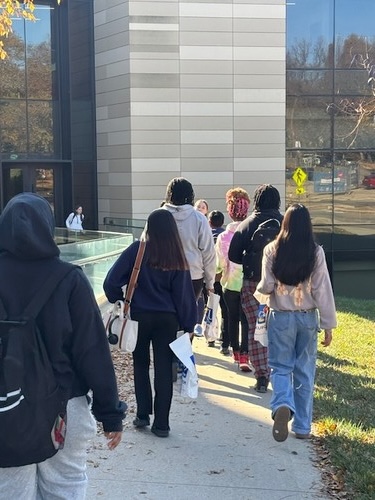
LNESC students on a college tour
First-hand campus experiences since 2013

Started in 2013, LNESC College Tours are day-long programs that provide high school juniors and seniors an opportunity to learn about the admissions process to enroll into post-secondary education by exposing students first-hand to a college campus.

The college tours provide students in select sites with the opportunity to learn more about the college admissions process, financial aid, campus life, as well as degree and career opportunities in various professional fields through presentations by university faculty and staff, and college students.

LNESC College Tours encourage students to enroll in pursue higher education opportunities through on-campus visits. This experience increases knowledge of university resources, and exposes students to campus life, academic programs and provides guidance in college access and decision-making on the choice for college. This contributes to the pursuit and successfully completion of a post-secondary degree.

48
college tours since 2013
4,260
participants served
~100
participants per visit
2013
touring since

Campuses we have visited

  • City College of New York - New York, NY
  • CUNY Bronx Community College - New York, NY
  • Florida International University - Miami, FL
  • University of Kansas - Lawrence, KS
  • Northeastern University - Boston, MA
  • Portland State University - Portland, OR
  • Roosevelt University - Chicago, IL
  • San Diego State University - San Diego, CA
  • Southern Methodist University - University Park, TX
  • Southern Illinois University - Carbondale, IL
  • Temple University - Philadelphia, PA
  • Texas A&M University - Corpus Christi, TX
  • Texas A&M University - Kingsville, TX
  • Texas Christian University - Fort Worth, TX
  • Texas State University - San Marcos, TX
  • University of California, Santa Barbara - Santa Barbara, CA
  • University of Central Florida - Orange County, FL
  • University of Central Missouri - Warrensburg, MO
  • University of Houston - Houston, TX
  • University of Illinois - Chicago, IL
  • University of Miami - Miami, FL
  • University of Missouri - Kansas City, MO
  • University of New Mexico - Albuquerque, NM
  • University of North Texas - Denton, TX
  • University of San Francisco - San Francisco, CA
  • University of Texas at Arlington - Arlington, TX
  • University of Texas at Dallas - Dallas, TX
  • University of Texas at El Paso - El Paso, TX
  • University of Texas at San Antonio – San Antonio, TX

Student Voice

This was a great experience! At first, I didn’t want to attend college, but now that has changed. I learned that college is important and that it’s mostly what we make of it and to get out of our comfort zone.
Student from Sunset High School, Dallas, TX

Student Voice

The most valuable things that I learned today were on admissions and financial aid. I also loved the way they encouraged us to do our best in completing our college applications.
Student from Raul Yzaguirre Schools for Success, Houston, TX
LNESC · Investment Impact Guide 2026
17
03Leadership Programs

Washington Youth Leadership Seminar

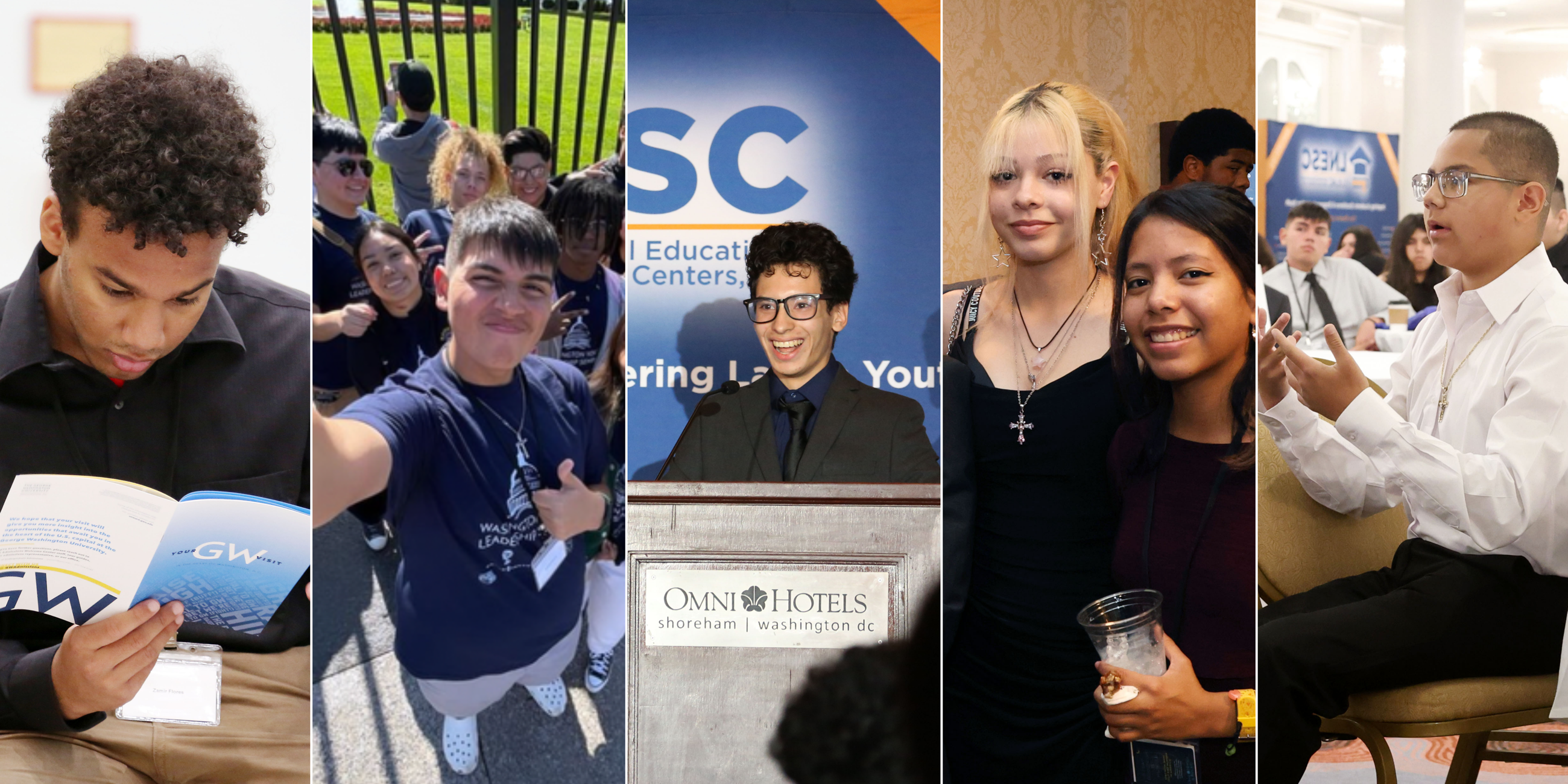
Washington Youth Leadership Seminar students learning and leading together
Civic leadership in the nation's capital

The Washington Youth Leadership Seminar (WYLS) is LNESC’s annual leadership development program that brings together approximately 50+ future rising leaders from across the U.S. and Puerto Rico to Washington, DC to immerse them with experiences focused on leadership, educational, and professional growth. Students are given the opportunity to learn what it takes to thrive as leaders from established professionals across sectors – including business, government, nonprofit, and beyond. Students undergo leadership training and peer bonding exercises, resulting in a tightknit group of leaders engaged and energized to make a difference in their community.

The program also highlights the effective ways to successfully manage the college admissions process and how to develop a career plan by understanding their true strengths, skills, interests and personal values — the lifelong foundation to a positive career identity. During the WYLS, participants connected with professionals from various nonprofit and federal agencies, corporate executives, and national organization leaders.

1,511
participants served since 1997
50
participants per seminar cohort
100%
plan local engagement
100%
will share learning

Participant States

  • Arkansas
  • California
  • Colorado
  • Florida
  • Iowa
  • New Mexico
  • New York
  • Ohio
  • Pennsylvania
  • Texas
  • Virginia
  • Washington
  • District of Columbia
  • Average of 50 participants per seminar cohort.
  • 100% of students reported they would likely get involved in their local communities after attending the WYLS.
  • 100% of students surveyed stating they would share what they learned at the WYLS with peers and friends in their community.

Student Voice

By participating in the 2025 Washington Youth Leadership Seminar (WYLS), it taught me more about leadership and caring for my community. My confidence levels have also intensified after attending this insightful seminar. Having been around others from different places has enhanced my perspective in understanding different viewpoints and cultures. From this leadership seminar, I will take this information to help advocate for my community. I will also be more open minded to unique ideas and expand my horizons in the career I want to pursue.
Natalia, High School Senior, Salinas, CA

Student Voice

WYLS helped me discover the power of my voice and the importance of civic engagement. I now feel more confident speaking up about issues that matter and plan to encourage others to get involved in local change. The seminar showed me that leadership isn’t about having all the answers, it’s about listening, learning, and taking action. I’m excited to bring this mindset back to my school and help foster a culture of collaboration and purpose.
Joaquin, High School Junior, El Paso, TX
LNESC · Investment Impact Guide 2026
18
03Leadership Programs

Hispanic Leadership Opportunity Program

Hispanic Leadership Opportunity Program students gathering together
Cultivating the next generation of leaders

The Hispanic Leadership Opportunity Program (HLOP) seeks to create a motivational environment for Hispanic high school students that encourages and nurtures them to become engaged in their communities, with a focus on cultivating and inspiring future Latino leaders.

The HLOP brings young people together with local business, political, and organizational leaders to discuss challenges facing their community. Participants observe, analyze and become directly involved with social, economic and local issues and the leaders who deal with those issues. In addition, participants are encouraged to exercise their leadership skills by becoming actively involved in leadership projects within their community. Through hands-on interaction with leaders and an emphasis on the value and role of leadership in addressing local issues, participants are challenged to become successful in their chosen profession and to give back to their communities.

The program helps students become part of the decision-making culture with an active role in the shaping of their community. Students gain a greater awareness of their own decision-making process and with it a respect for the unique world-view of others. Through hands-on interaction and an emphasis on the value and role of leadership in addressing the needs of Hispanic, participants are challenged to become successful in their chosen profession, while becoming change agents for their chosen values.

5,541
participants served since —
25-30
participants per program cycle
25+
students

Program Locations

  • Kansas City, Missouri
  • Average of 25 - 30 participants per program cycle.
  • 25+ students.
Partnership Levels
$30,000 – $45,000
LNESC · Investment Impact Guide 2026
19
Scholarship Initiatives
LULAC National Scholarship Fund

In 1975, LNESC created the LULAC National Scholarship Fund (LNSF) to help youth in underserved communities make the dream of a college degree a reality. The LNSF solicited funds from major corporations to supply scholarships for underserved students. The program was expanded in 1976 to involve local LULAC councils by matching their fundraising efforts with funds from corporate grants. Today, the LNSF is a unique partnership between grassroots advocates and corporations that funds awards for talented youth across the U.S. Every dollar raised by the local LULAC Councils is matched by corporate partners secured by LNESC, increasing the amount awarded in both the council and corporate names. This results in a true grassroots/corporate partnership for the empowerment of the community.

Former recipients of LNSF scholarships are now leaders in fields of business, science, government, and education. A rigorous selection process assures the expectation that future recipients will demonstrate the same level of excellence.

Since 1975
40,003
Scholarship recipients
$22.1M
Awarded since 1975
~1,000
Scholarships awarded annually
~60
LULAC Councils participating

Program Locations

Arkansas · California · Florida · Illinois · Iowa · Kansas · Massachusetts · Ohio · Pennsylvania · Texas · Wisconsin · Washington, DC

Our Impact

  • Average of 1,000 scholarships awarded annually
  • Average of 60 LULAC Councils participate
  • Average of $700K awarded annually
  • 40,003 scholarship recipients have been awarded $22,119,584.56 since 1975
Computers have always fascinated me. I grew up watching my four older siblings program computers and robots. I followed in their footsteps officially when I joined a FIRST robotics team in sixth grade. Since then, my desire to work with computers and robots has flourished. My career goal is to develop new technology to fix medical problems. This area interests me because I needed heart surgery when I was only thirteen years old. I want to be on the ground floor, helping make medical advances possible and affordable through new technology. The LULAC Scholarship has helped tremendously toward my education at the University of St. Thomas in St. Paul, MN, where I am pursuing a computer engineering degree. I am enjoying the St. Thomas community and the larger Twin Cities.
Jerry, Student at University of St. Thomas, Computer Engineering
Growing up, I watched my parents work tirelessly to give my siblings and me a better life, and their constant determination became my biggest source of inspiration. Seeing their sacrifices taught me the importance of education, perseverance, and using every opportunity to grow. This scholarship has made a huge difference in my journey by easing financial stress and allowing me to focus on my classes and goals instead of constantly worrying about expenses. It’s given me the space to stay motivated, maintain strong grades, and keep moving toward my dream of becoming a speech-language pathologist. My father, especially, inspires me every day, he never stops working to support our family, always finding new ways to improve our lives and showing me what true dedication looks like. This scholarship doesn’t just provide financial support; it reminds me that my goals are within reach and that there are people who believe in students like me who want to make a difference in their communities.
Danna, Student at California State University, Sacramento, Communication Sciences and Disorders
As a first-generation college student, attending Rice University has been a dream realized and a testament to perseverance. I am majoring in Mathematical Economic Analysis, with aspirations to pursue intellectual property law and eventually attend Harvard Law School. The LULAC National Scholarship Fund has been more than financial support, it has been a source of confidence and encouragement. Knowing that LULAC believes in my potential reminds me that I belong in spaces like Rice and beyond. My parents’ sacrifices in coming to America inspire me every day. Their journey instilled in me a deep appreciation for education and the determination to create a path for future generations. The challenges to get here were not easy, but with LNESC’s support, I feel empowered to keep striving and to give back.
Sofia, Student at Rice University, Mathematical Economic Analysis
As a first-generation college student studying Petroleum Engineering at the University of Texas at Austin, my journey has been driven by curiosity, resilience, and a desire to open doors for others like me. Growing up, I was fascinated by how energy powers our world and wanted to be part of building a more sustainable future. Choosing petroleum engineering wasn’t just about science—it was about finding innovative ways to make a lasting impact in an industry that touches so many lives.
Santiago, Student at University of Texas at Austin, Petroleum Engineering
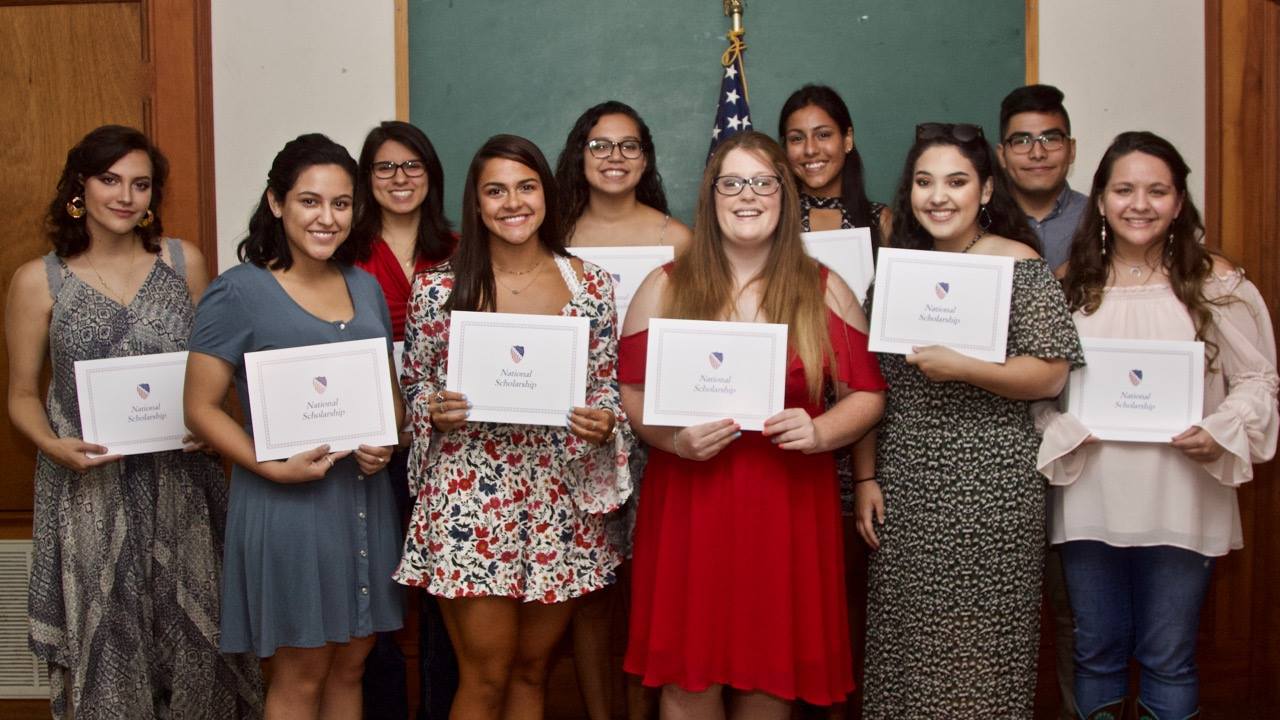
Graduates celebrating together
LNESC Investment Impact Guide20
Scholarship Initiatives
Specialized Scholarships & Resources
Specialized Scholarships
Specialty Scholarships are made possible through LNESC longstanding partnerships with leading corporations across sectors. Through these partnerships, LNESC provides a number of important scholarship opportunities that offer financial support with awards that range in amounts and have varying eligibility criteria. Awards are granted based on fields of study, geographic area, financial need, and more.
Ford Philanthropy

Ford Philanthropy Scholarship Program

The Ford Philanthropy Scholarship Program supports first-generation students attending four-year colleges who are pursuing careers in STEM fields connected to the automotive and mobility industries. The Ford Auto-Tech Scholarship initiative promotes the Ford Auto-Tech Scholarship Program to students attending two-year and four-year colleges in select schools across the country. These funds help students thrive in their studies and develop critical Future of Work skills that carry them beyond graduation.

Macy's

Macy's Emergency Scholarship Fund

Funded by Macy's, LNESC provides emergency funds to qualified undergraduate and graduate students experiencing economic hardship and immediate monetary need that, if not met, could result in an inability to complete classes or a degree program.

Resources
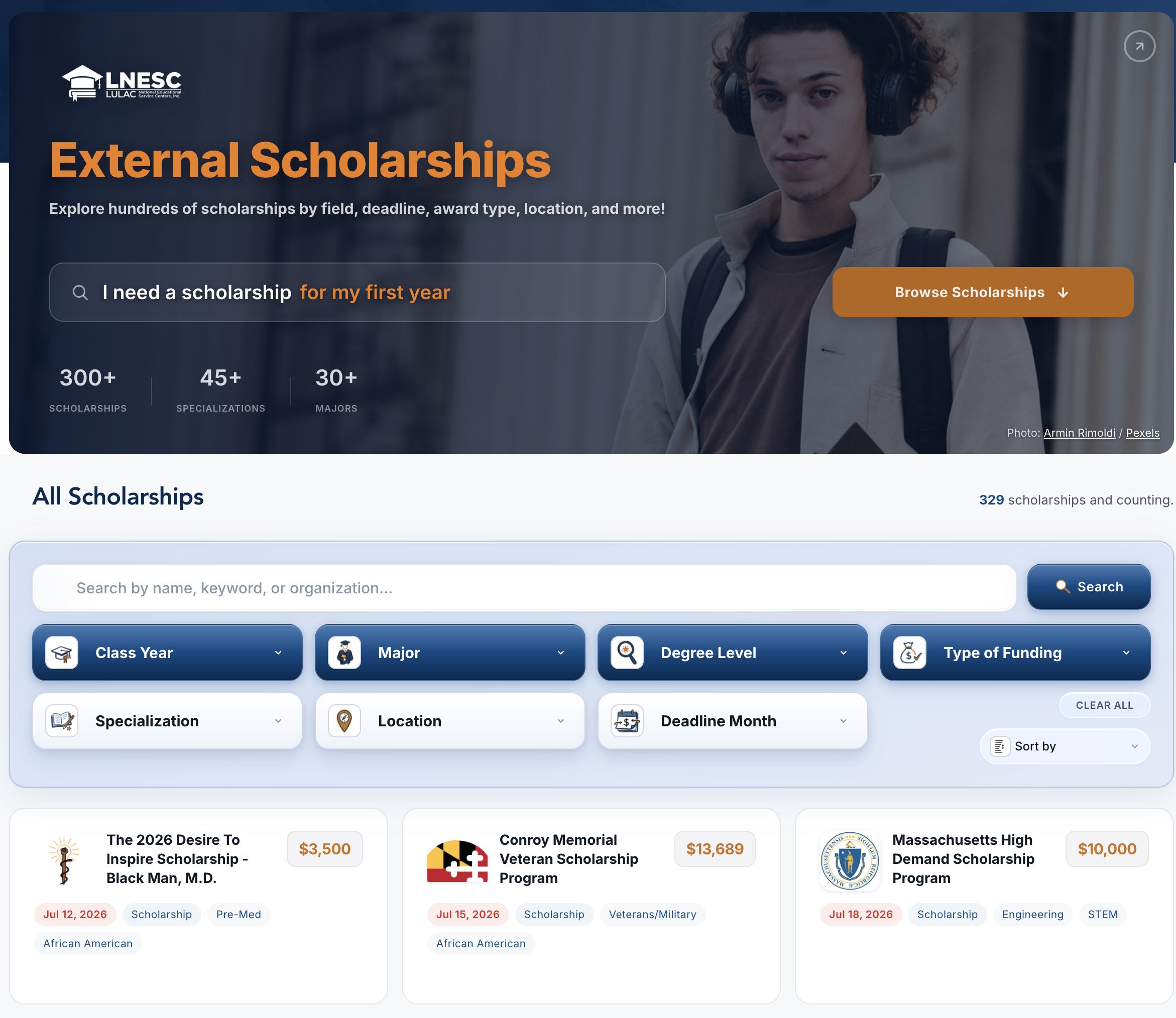
LNESC offers a broad array of resources designed for students at every stage of their educational journey, from high school and undergraduate study to skilled occupations and nontraditional pathways. Support includes an external scholarship directory, mental health resources, financial aid guidance, academic tools, career planning, and services tailored to students' changing needs. Updated in 2026, the external scholarships hub is searchable across more than 40 specializations and features a wide range of opportunities with deadlines throughout the year.
LNESC searchable scholarships hub
LNESC undergraduate resources hub
Scholarship Search
Mental Health
Career Planning
Financial Aid
LNESC Investment Impact Guide21
Scholarship Initiatives & Partnerships
Partnerships

We’ve enjoyed continued success because of the partnerships we’ve formed with established and respected corporations and organizations. We offer our sincere appreciation for their support and commitment to our mission of providing the highest quality educational opportunities to disadvantaged students across the United States of America and Puerto Rico.

Our Programs
Federal TRIO Programs
Upward Bound Math & Science
Young Readers
Science Corps & STEM Explorers
Digital Education
Caminos to College & Careers
College Tours
Washington Youth Leadership Seminar
Hispanic Leadership Opportunity Program
LULAC National Scholarship Fund
Our Reach
Map of LNESC education centers across the United States and Puerto Rico
LNESC Investment Impact Guide22
LNESC · Est. 1973

Inspiring Academic Excellence
& Empowering Youth
One Student at a Time

Interested in partnering with LNESC?

Join us in inspiring academic excellence and empowering youth nationwide.

Become a Partner
LNESC
LULAC National Educational Service Centers, Inc.
1150 18th Street NW, Suite 650  |  Washington, DC 20036
(202) 835-9646 ext. 113  |  Development@LNESC.org
WWW.LNESC.ORG  ·  @LNESC